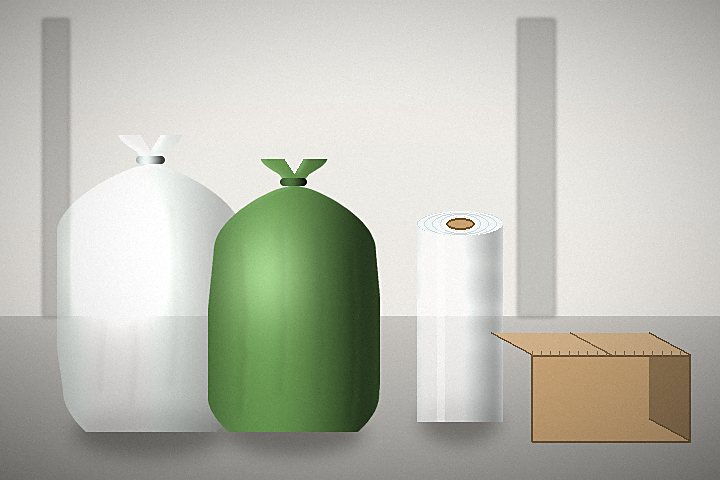
Food contact is a specification, not a property. The same sack from the same line is food-contact grade only if it was ordered, produced and documented as such — which is why this page starts with the paperwork rather than the product.
Documentation, supplied per line
Every food-contact line ships with:
- Declaration of compliance to Regulation (EC) 1935/2004
- for plastics, compliance with Regulation (EU) 10/2011, including migration testing where the application requires it
- manufacturer’s BRCGS Packaging certificate for food-contact film and liners
- ISO 9001 and, where held, ISO 22000
- traceability: batch and production date per pallet
If your customers audit you, these are the documents that get asked for. They ship with the order rather than being produced on request three weeks later.
What you buy
| Product | Typical specification | Use |
|---|---|---|
| Clear sacks, food grade | 30–50 µm virgin LDPE | product handling, liners |
| Bin liners | 50 µm | processing waste |
| Compostable caddy liners | EN 13432 | organic waste separation |
| Stretch film | 17–23 µm | palletising, including chilled |
| Pallets | ISPM 15 where exported | despatch |
Specifications, pack quantities and minimum orders for each: bin liners, stretch film, cling film.
Recycled content and food contact
Recycled plastic is permitted in direct food contact, but only on terms most suppliers cannot meet. Regulation (EU) 2022/1616 governs it: the recycling technology has to be a suitable one, the individual recycling process has to be authorised or running under a registered scheme, and the material has to be appropriate for the intended use and conditions. Mechanical recycling of PET through authorised processes is the established route. General post-consumer polyethylene from a mixed household stream is not, because the input cannot be shown to have been food-grade.
So the honest answer is not “PCR is banned in food contact” — that is wrong, and a buyer who repeats it to an auditor will be corrected. The answer is that the process has to be authorised for the material and the use, and the supplier has to be able to name it.
For the products on this site the practical position is unchanged: we put PCR in the waste sacks and in transit film that never touches product, and we do not offer it in direct food-contact film. Not because the law forbids it outright, but because no authorised process supports polyethylene cling film for direct food contact from post-consumer input.
A supplier offering you 50% PCR in a direct food-contact film should be asked one question: which authorised recycling process, and under what authorisation number. If that question produces a pause, you have your answer.
Temperature
Two effects worth specifying around:
Chilled and frozen. LDPE stays flexible well below zero; HDPE becomes brittle. For anything handled in a freezer, specify LDPE even where HDPE would otherwise do the job at lower cost.
Stretch film in cold stores. Cling drops as temperature falls. Film that holds a pallet at 20 °C can release at 2 °C, and the usual fix is not more wraps but a formulation specified for chilled use. Tell us the temperature and we will quote the right grade.
Hygiene in the plant
- Colour-code the waste streams so that a sack from the production hall is visibly different from one out of the canteen. 500 kg minimum per colour.
- Avoid printed sacks in the production area where ink transfer is a hazard in the risk assessment; print the case instead.
- Specify a case that does not shed fibre — a BRCGS plant manages this, a general-purpose plant may not.
Common mistakes
- Assuming food contact by default. It has to be ordered and it appears on the order confirmation. Without that line, it is not food-contact stock.
- Specifying HDPE for freezer use. It saves money and fails cold.
- Using the same film year-round. Cold-store cling is a different grade.
- Leaving migration testing until an audit. Ask at specification stage; it is routine and slow to retrofit.