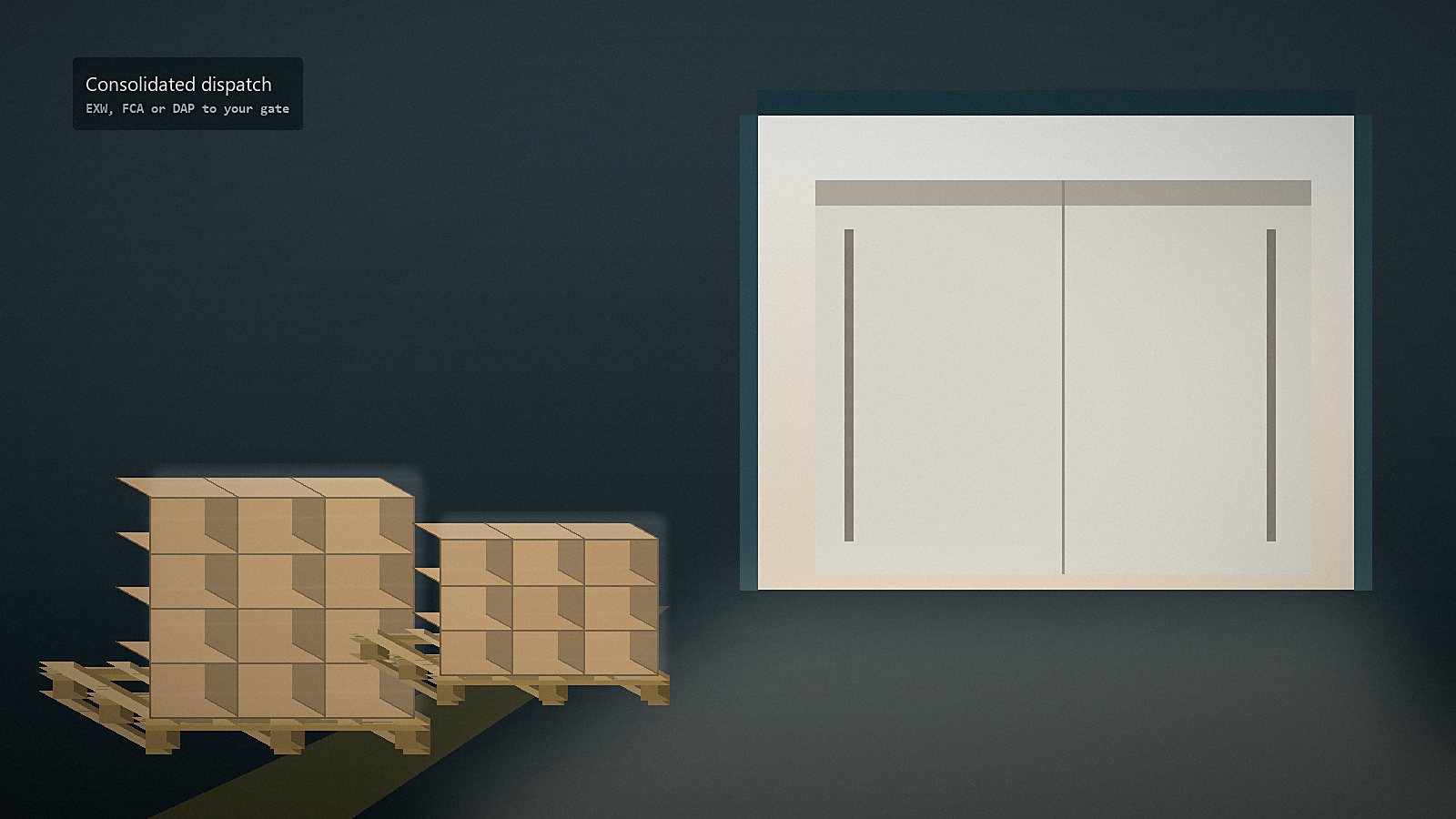
Packaging is a high-volume, low-density freight. A trailer fills up long before it reaches its weight limit, which makes the Incoterm and the load plan matter more than they would for dense goods.
The three terms we quote
EXW — Ex Works
You collect from the manufacturer’s works in Poland. You arrange the vehicle, and you carry the cost and the risk from the moment the goods are made available.
Use it when you have your own transport, a consolidator in Poland, or a groupage contract that beats what we can arrange.
Watch for the loading itself: under EXW 2020 the seller is not obliged to load the vehicle. The plants in our network do load, and we get that written into the quotation rather than left to custom — but if you are comparing an EXW price against another supplier’s, check whether theirs includes it.
FCA — Free Carrier
The plant delivers the goods, cleared for export where that applies, to a carrier you nominate. Where delivery is complete depends on the named place. At the plant’s premises it is complete once the goods are loaded onto your carrier’s vehicle. At any other named place it is complete when the goods arrive on the plant’s vehicle, ready for unloading — the plant does not unload.
Use it when you have a nominated carrier but want the export formalities and loading handled at the Polish end. For most buyers arranging their own transport, FCA is the better choice than EXW because the risk transfer point is unambiguous — provided the named place is written on the quotation. “FCA Poznań plant” and “FCA Poznań terminal” are different deals.
DAP — Delivered at Place
The plant delivers to your address, arranges and pays the freight, and carries the risk until the goods are ready for unloading at your gate. You unload. Import duties, if any, are yours — inside the EU there are none.
Use it when you want one number to compare against your current landed cost. This is what most buyers should ask for on a first order, because it is the only term where the quotation and your current supplier’s price mean the same thing.
What we do not quote
DDP. The two terms are not interchangeable, although inside the EU they can look it. DAP puts import clearance, duty and import VAT on the buyer; DDP puts them on the seller. For an ordinary movement between member states there is no import customs clearance to perform, so on a Poland-to-Germany road shipment the practical difference is close to nothing — which is why quoting DDP there adds paperwork without adding certainty.
Take the same load outside the single market and the difference is the whole deal. DDP makes the seller responsible for clearing goods into a jurisdiction it may not be established in, and for taxes it may not be able to reclaim. That is a real liability, not a formality, and it is the reason the ICC advises caution with the term.
Either way, the party that carries it is the manufacturer, since the supply contract is theirs. We say so at quotation stage rather than letting a template decide it.
CIF and FOB. These are sea-freight terms. Using them for a road shipment from Poland to Germany is a common error in tender documents; if your template demands one, tell us and we will map it to the correct road equivalent in writing rather than signing something that does not describe what happens.
Load planning
| Vehicle | Euro pallets | Typical use |
|---|---|---|
| 13.6 m curtainsider | 33 | full load, DE / NL / Nordics |
| 13.6 m, double-stacked | up to 66 | light goods, sacks and film |
| 7.2 m rigid | 18 | part-load, short haul |
| 40 ft container | 25 | overseas, rare for this trade |
| 20 ft container | 11 | overseas |
Thirty-three euro pallets is the practical maximum on a standard European trailer. Sacks and film are light enough to double-stack, which is why a mixed load of sacks and film often ships at close to full trailer economics even when the weight is modest.
Our truck and pallet load calculator runs the same arithmetic we use when quoting, so you can check a configuration before asking for a price.
Transit times from Poland
| Destination | Full load | Part load |
|---|---|---|
| Germany | 2–3 days | 3–5 days |
| Netherlands, Belgium | 2–4 days | 4–6 days |
| Denmark | 3–4 days | 5–7 days |
| Sweden | 5–7 days | 7–10 days |
| France | 3–5 days | 5–8 days |
Part-loads wait for a vehicle going the same way, which is where the extra days come from. If a date is firm, say so at enquiry stage and we will quote a dedicated vehicle instead.
Documents
Every shipment travels with a commercial invoice, a packing list showing every line against its pallet, and a CMR. Orders in PPWR scope also carry their manufacturer’s Declaration of Conformity pack and a packaging weight breakdown by material for your EPR return.
Intra-EU shipments need no customs declaration. For deliveries outside the EU the plant issues the export declaration and, where the destination requires it, an EUR.1 movement certificate or a statement on origin. We make sure it is agreed at quotation stage rather than discovered at a border.
Note: ISPM 15 heat treatment applies to wooden packaging leaving the EU, not to intra-EU movements. If you re-export goods on wooden pallets to a third country, those pallets must be ISPM 15 treated from the start — retro-treating a loaded pallet is not practical.