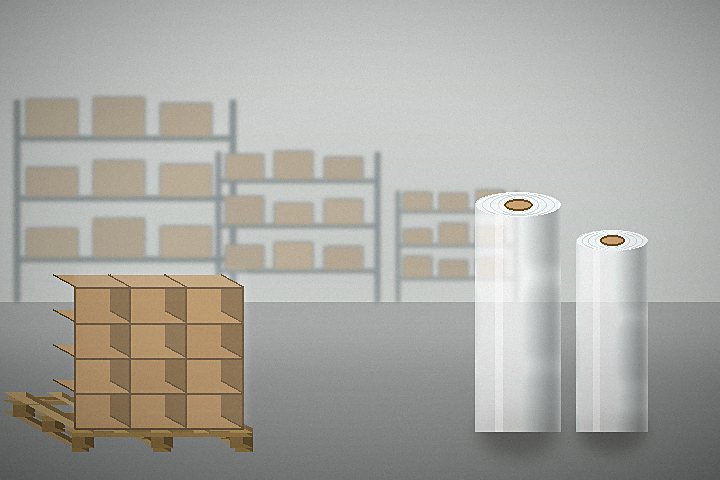
A 3PL buys consumables the way a factory buys raw material: by consumption per unit of output. The right unit here is cost per pallet wrapped, and almost every film buying decision made on price per roll turns out wrong when converted to it.
What you buy
| Product | Typical specification | Use |
|---|---|---|
| Machine stretch film | 17–23 µm cast, 500 mm × 1500 m | automatic wrappers |
| Pre-stretched film | to 300%, 12–15 µm effective | high-volume lines |
| Hand stretch film | 23 µm, 500 mm × 300 m | dock and pick-face |
| EPAL euro pallets | 1200 × 800 × 144 mm | pooled and owned stock |
| One-way export pallets | 1200 × 800 mm | outbound, non-return |
| Refuse sacks | 50 µm | packaging waste at the pick face |
Specifications, pack quantities and minimum orders for each: bin liners, stretch film, cling film.
Cost per pallet, not price per roll
The arithmetic that matters:
film per pallet (g) = wraps × pallet circumference × film width
                      × micron × 0.92 ÷ (1 + pre-stretch)
cost per pallet     = film per pallet ÷ 1000 × price per kg
Two consequences that reverse most purchasing decisions:
A thinner film is not automatically cheaper per pallet. If a 17 µm film needs five wraps where a 20 µm film needs four, the thicker film wins.
Pre-stretch dominates everything else. Film pre-stretched to 300% delivers the same containment with 30–50% less material. On an operation wrapping 200 pallets a day, that is the largest single consumable saving available, and it usually exceeds any price negotiation on the film itself.
Our stretch film cost calculator runs this on your own numbers, including the annual saving from switching to pre-stretched film. The result is shown in full — no email required.
Hand film or machine film
Above roughly 30 pallets per shift, a wrapper pays for itself in film alone, before labour. Below that, hand film is the right answer and a machine is capital tied up in a corner.
Where an operation is near the threshold, the honest comparison includes the labour: hand wrapping is 60–90 seconds per pallet, machine wrapping is 20–30 seconds plus the walk.
Pallets: the number that surprises people
EPAL publishes a 1,500 kg safe working load for a compliant pallet, and one further figure that is routinely misread: when laden pallets are stacked on a solid, even surface, the bottommost pallet must not exceed 5,500 kg. That is a stacking condition, not a static capacity, and it is not a rack rating.
There is no EPAL racking figure, and that is the point. Rack capacity is a property of the racking system, not of the pallet — so in a warehouse the number that binds comes from whoever engineered the beams. Anyone quoting you a universal racked load for a Euro pallet is repeating something they read.
For outbound loads that will not return, a one-way pallet at a lower price makes sense — but check the destination first. ISPM 15 treatment is required for wooden packaging leaving the EU and is not retro-fittable to a loaded pallet.
Load planning
Thirty-three euro pallets fit a 13.6 m curtainsider. Light goods — sacks and film — double-stack, which is how a mixed load reaches full-trailer economics on modest weight. The truck and pallet load calculator runs the same arithmetic we use when quoting.
Common mistakes
- Comparing film on price per kilo. Compare cost per pallet wrapped.
- Buying rolls by count rather than net weight. A roll 200 g light across a pallet of fifty rolls is 10 kg of missing film.
- Taking a racking figure from a pallet datasheet. EPAL does not publish one. It comes from whoever engineered the beams.
- Running machine film through a hand dispenser. Different formulation, different cling, and it will not hold.