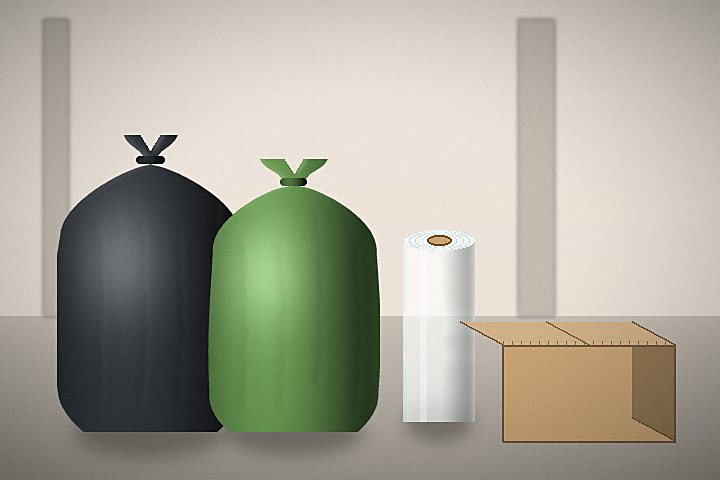
Hospitality waste is wet, heavy and sharp, and it is carried by hand through corridors and down service stairs. That combination decides almost every specification on this page.
What you buy
| Product | Typical specification | Where |
|---|---|---|
| Heavy duty refuse sacks | 50–60 µm, 700 × 1100 mm, star sealed | kitchen, wet waste |
| Extra heavy sacks | 70 µm, 800 × 1200 mm | glass, tins, bones |
| Compostable caddy liners | EN 13432, 10–30 L | food waste separation |
| Clear sacks | 40 µm | glass and dry recycling |
| Wheelie bin liners | 50 µm, 240 L and 1100 L | bin store |
| Stretch film | 23 µm hand film | securing trolleys and deliveries |
Specifications, pack quantities and minimum orders for each: bin liners, stretch film, cling film.
The hidden cost: double-bagging
If your kitchen porters put one sack inside another, the sack specification is wrong and you are paying twice for it. Two 30 µm sacks cost more than one 60 µm sack, take twice as long to change, and still split — because two thin films do not behave like one thick one.
Where double-bagging is happening, one of three things is true:
- The gauge is too low for wet waste. Below 50 µm, water weight plus a bone or a broken glass gets through.
- The base is flat sealed, not star sealed. A star seal folds the base into four gussets so the load spreads; a flat seal concentrates it on one weld, which is where it fails when the sack is lifted.
- The sack is too small, so it is overfilled and stressed at the rim.
Food waste separation
Compostable caddy liners to EN 13432 only make sense where the waste actually reaches industrial composting. In a municipality that incinerates food waste, a compostable liner is a more expensive sack with no environmental benefit — we will ask which applies to you before quoting.
Note that EN 13432 is industrial compostability, not home compostability, and that “biodegradable” without a standard reference means nothing.
Seasonal and event volumes
Hospitality demand is spiky. Two things help:
- Hold a buffer, not a forecast. A pallet of sacks occupies about 1.2 m² of floor and does not perish. Running out mid-service costs more than storing it.
- Order the peak six weeks out. September to November is the busiest quarter in packaging across Europe, which is exactly when Christmas event volumes are ordered — and when lead times are longest.
Consolidation
A hotel group buying sacks from one supplier, pallets from another and film from a third is running three accounts for perhaps two pallets a month in total. That is precisely the case for putting all three on one specification and letting the plants quote against it, rather than renegotiating each account separately every quarter.
Common mistakes
- Buying the same sack for front and back of house. Bedroom bins do not need 60 µm; kitchens do.
- Specifying by litres. See bin liner size finder.
- Assuming clear sacks are weaker. Clear film at the same micron performs the same; the difference is cost of pigment, not strength.