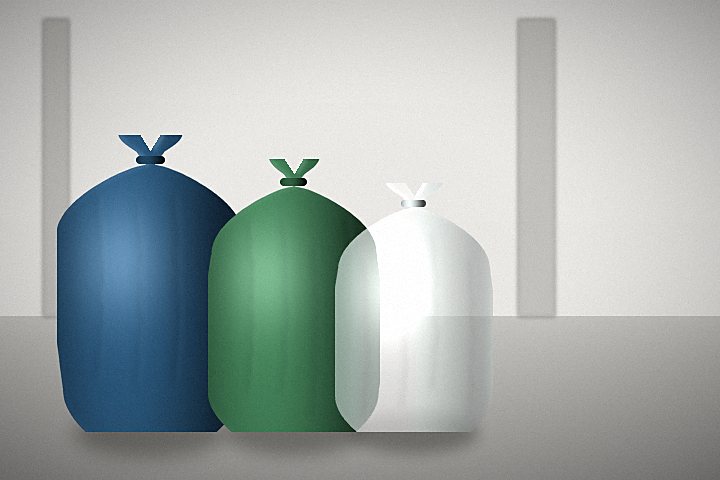
Scope, stated first: we cover non-clinical waste streams — domestic, recycling, dry mixed, and back-of-house packaging. We do not cover clinical, infectious or sharps waste containers, which are regulated products requiring UN approval and a different supply chain. A supplier who offers you both without mentioning the distinction is worth checking carefully.
What you buy
| Product | Typical specification | Stream |
|---|---|---|
| Heavy duty sacks, black | 50 µm, 700 × 1100 mm | general domestic |
| Sacks, blue | 40–50 µm | dry mixed recycling |
| Sacks, green | 40–50 µm | glass or food, per local scheme |
| Clear sacks | 40 µm | streams requiring visual check |
| Wheelie bin liners | 50 µm, 240 L and 1100 L | bin store |
| Stretch film | 23 µm hand, 17 µm machine | pallet consolidation in stores |
Specifications, pack quantities and minimum orders for each: bin liners, stretch film, cling film.
Colour coding
Colour codes differ by country and often by trust or region, so we produce to your scheme rather than to a house standard. The constraint is the run size: 500 kg per colour per specification, which is roughly 12 000–25 000 sacks.
For a hospital site that is a manageable quantity. For a small care home it is not, and printed labelling on clear sacks is the cheaper route — we will say so.
Specification for a tender
Healthcare procurement is documented procurement. A specification that will survive review states, per line:
- material (LDPE / HDPE / PCR blend and percentage)
- gauge in microns, with the tolerance (nominal −5%)
- useful width and length in millimetres, per EN 13592
- seal type (star seal)
- colour, with a reference sample agreed
- pack quantity and cases per pallet
- EN 13592 conformity, with test evidence
We get that out of the plant as a specification sheet per line, plus the ISO 9001 certificate for the producing site and the Declaration of Conformity the PPWR has required since 12 August 2026. All of it ships with the order rather than being produced when the auditor asks.
Tear resistance is the property that matters
In a ward or corridor, a sack is carried past door frames, trolleys and bed rails. The failure mode is a snag propagating into a tear, not a burst.
LDPE resists tear propagation considerably better than HDPE at the same gauge. HDPE is cheaper per sack and perfectly good for light dry waste in a bin that is lifted straight out — but for anything carried any distance, LDPE at 50 µm outperforms HDPE at the equivalent price point in the way that actually matters.
Recycled content in a healthcare tender
30% and 50% PCR sacks are available across the colour range and are increasingly asked for in public tenders. Above 50%, the grey cast becomes visible in lighter colours and the puncture resistance drops — for a clear stream sack that must be visually inspected, we would advise against it and explain why in writing so the answer is on file.
Common mistakes
- Ordering by litre rating. Two “240 litre” sacks can differ by 80 mm in width, and one of them will not turn over the bin rim.
- Specifying HDPE to save money on a carried stream. The saving is real; the tear performance is not equivalent.
- Leaving conformity evidence until audit. Ask for it with the goods; it costs the supplier nothing and saves you a week.